Attic ventilation and your new roof
Air has to move through an attic for a roof and the house beneath it to stay healthy.
September 30, 2026 · 4 min read
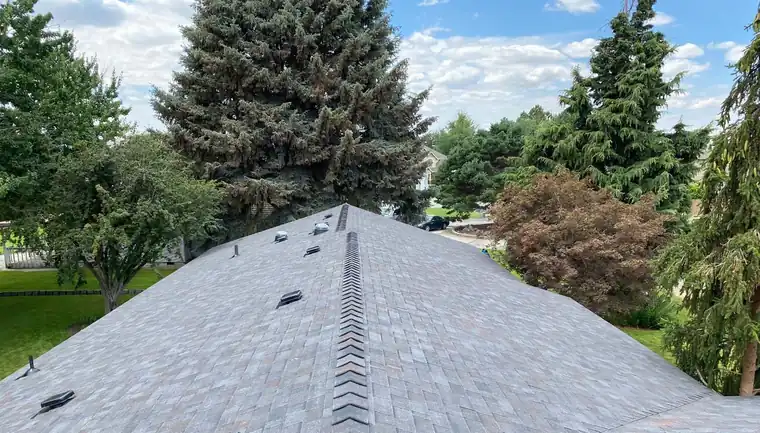
Attic ventilation is one of those things nobody thinks about until a roof is being replaced. Then it matters a great deal, because the replacement is the cheapest and easiest time to fix it. When the old shingles are off, the roofer can see exactly what vents the roof has and add, move or replace them as part of the job.
What an attic vent system does
A ventilated attic is a space where outside air flows in low, rises, and leaves high. Air enters through intake vents, usually in the soffits under the eaves. It leaves through exhaust vents near the top of the roof, such as a ridge vent along the peak or box vents spaced across the slope. Warm air rises on its own, so the system works without fans when the intake and exhaust are balanced.
In summer, that moving air carries heat out before it can bake the underside of the roof deck and push heat into the rooms below. In cold weather, it carries away the moist air that leaks up from the house, which otherwise can condense on cold wood in the attic. Heat and moisture are the two things a roof system has to manage, and ventilation is the part of the system that handles both.
Why balance matters more than quantity
More vents are not always better. What counts is that intake and exhaust work together. A roof with plenty of exhaust at the top but blocked or missing intake at the eaves has nowhere to draw fresh air from, and the exhaust vents can end up pulling air from the house instead. A roof with generous intake but poor exhaust lets air in with nowhere to go.
- Intake: soffit vents or other low vents at the eaves, kept clear of insulation and paint.
- Exhaust: ridge vent or box vents near the top, cut properly through the roof deck.
- Insulation baffles that keep attic insulation from blocking airflow at the eaves.
- Bathroom and kitchen fans vented outside the house, not into the attic.
Why it goes in with a re-roof
A ridge vent needs a slot cut along the peak, and box vents need holes cut through the deck. Both are far simpler to install while the roof is bare than to add later through finished shingles. A re-roof is also the moment to look at the attic from above and below and see whether the soffits are open, whether insulation is blocking the eaves, and whether any vent has failed.
David Law, who reviewed Black Diamond on Google, said his family needed “a new roof with improved ventilation to our attic.” He added that of all the quotes he received, Black Diamond's stood out, that the estimator took his time going over everything, and that the replacement took two days. That is a good example of a homeowner treating ventilation as part of the roof instead of an afterthought.
Signs your attic is not breathing well
Some of the signs show up inside the house and some on the roof. If you see several, ask for ventilation to be part of the estimate.
- An upstairs that stays much hotter than the rest of the house in summer.
- Frost, damp wood or dark staining on the underside of the roof deck in winter.
- Insulation that looks compressed, damp or moldy.
- Rusted nail tips poking through the deck into the attic.
- Shingles that wear or curl much faster on one slope than the others.
None of these proves a ventilation problem alone, since insulation, air leaks and the roof's own age all play a part. They are a reason to look.
Questions to ask your roofer
Before you sign, ask the roofer to show you how the attic is vented today and what will change. Ask where the intake is, where the exhaust is, and whether the two are in balance. Ask whether the soffits are open and whether anything inside the attic is blocking them. Ask what will be installed on the ridge, and how it will be sealed against wind-driven rain and snow. And ask that the answers go into the written estimate, so everyone is working from the same plan.
Also read the shingle manufacturer's installation and warranty documents, or ask your roofer to walk you through them. Manufacturers publish their own requirements, and a good contractor will know them. Black Diamond is a certified installer through GAF, Malarkey and Owens Corning, and its estimates are free.
Start with a look from the attic
If you are planning a new roof in Richland, Kennewick, Pasco or West Richland, ask for the attic to be part of the inspection. Call Black Diamond at (509) 943-ROOF or text the owner at (509) 308-6656 to set up a free estimate.
Black Diamond Roofing & Construction, (509) 943-ROOF
Call (509) 943-ROOFMore articles
Repair or replace: how to read an aging roof in the Tri-Cities
A roof wears out in stages, and knowing the stages helps you decide between a patch and a new roof.
What happens on roof replacement day
A replacement looks chaotic from the driveway, but a good crew follows the same order every time.